Companies making the decision to rebrand are often unclear if they need a brand refresh or a brand overhaul. This guide covers how to tell which option is best for you, what each path involves, how long the process takes, what it costs, how to know whether it worked, and how to choose someone to lead the project.
The rebranding process should always involve research, positioning strategy, visual identity, website, and a rollout plan.
A rebrand effort can take anywhere from 4 weeks to 6 months. Your timeline relies on your scope, feedback agility, and stakeholder team.
The efficacy of your rebrand can — and should be — measured. Record your website, pipeline, and hiring numbers before the work starts.
Talent-wise, you have 4 options for who you can tap to lead your rebrand: an internal hire, a freelancer, an agency, or a founder-led studio.
How do I know if I need a brand refresh or brand overhaul?
Brand problems take form in a few classic symptoms:
Sales cycles are drawn-out; prospects need substantial time and trust before getting on board
Newer competitors with less delivery depth and less impressive rosters are winning on the basis of presentation; simply because they look the part
Your visuals fail to represent the caliber of your work product; you avoid sharing your website with prospects
Strong technical candidates take offers with other firms
Examples: Companies in a strong position to revisit their brand
A cloud consultancy building direct pipeline after years of marketplace-sourced work. The brand was built to be read by a partner manager and now has to be read by a CTO who has never heard of them.
A company whose category is being redefined by faster, newer entrants. Deeper expertise and a more impressive client roster, but a dated and immature brand presentation.
An MSP three acquisitions in, running four legacy names across one operation. Nothing in the existing brand describes the combined value proposition, and/or each inherited brand carries its own market expectations.
A consultancy struggling to retain and backfill roles. The brand signals a smaller shop than reality, and hiring teams struggle to speak to the culture and true breadth of career opportunity.
A regional accounting firm moving from compliance work into advisory. After pivoting, the brand still describes the business they used to run, and a refresh of the value proposition is needed.
In each of these, the distance between what the firm delivers and what the brand communicates is already showing up in pipeline, in hiring, or in both.
What is the difference between a brand refresh and a brand overhaul?
A brand refresh updates your story but preserves your core identity. A brand overhaul is a total reset of who you are.
Refresh | Overhaul | |
|---|---|---|
Name | Keeps | Often changes |
Positioning | Sharpens what is already true | Replaces the story |
Visual identity | Evolves from what exists | Built new |
Client recognition | Preserved deliberately | Broken deliberately |
Announcement need | Optional | Required |
Typical trigger | Moving upmarket, new buyer, new market | Merger, acquisition, category exit, legacy baggage |
In a brand refresh, existing clients recognize you and notice that something has changed. The name stays, the equity carries forward, and your positioning, messaging, and visual system are updated rather than replaced.
In a brand overhaul, you are asking the market to forget everything it knew about you. This requires an announcement, a transition plan, and often a new name. Overhauls carry more risk but also more upside, granting you the opportunity to start from scratch.
Should we refresh or overhaul our brand?
These questions can help you gauge the refresh or overhaul decision:
1. Does your brand still fit what you sell?
This is the question to ask if you've recently expanded your services or solutions - and even more so if AI disruption has affected your value proposition. If you've evolved your delivery significantly since your last branding exercise, an overhaul could make sense.
2. Is there equity worth carrying forward?
Having a well-established name in your space could make it so that a total overhaul is too drastic a change. It could very well be that a refresh of your messaging language, color scheme, typography system, and logo mark could be all that's needed to stay current.
3. Is there something you need to leave behind?
This could take the form of a less-than-desirable reputation or association, a disjointed family of acquired companies, or a past category that you’ve exited. Scenarios like these would put a firm squarely in overhaul territory.
What does the rebranding process actually involve?
The typical rebranding process involves five different stages. This is how our team at Aurra typically approaches projects:
Research and discovery. Client interviews, competitive analysis, internal stakeholder sessions. This insight closes the gap between how you view yourself and how the market perceives you.
Positioning strategy and messaging. The platform that establishes who you serve, what you claim, and why it should matter to your audience. Depending on the extent of the update, this phase can also involve the renaming process.
Brand identity design. Logo, color, typography, brand guidelines, and agentic design systems that govern how the identity comes to life visually.
Website copywriting, design, and development. Architecture, copy, and design that clarifies your market position, compels leads, and makes your identity tangible.
Brand rollout. Creation of new materials like social media profiles, proposal documents, presentation templates, partner portals, and any other customer-facing brand assets.
How long does a rebrand take?
The rebrand process can take anywhere between 2 weeks to 6 months. The total timeline is determined by a number of factors, such as:
how extensive your initial research is (conducting interviews; implementing surveys can add significant time to a project)
the total number of stakeholders involved in the process (the larger the group, the more complex and time-exhaustive it can be to make decisions)
how quickly you can review deliverables and provide quality feedback to your creative team
the complete scope of the effort (naming, website redesign, and rollout plan are all factors in total turnaround time)
These factors all inform the total amount of time that your rebrand process can involve.
What does a B2B rebrand cost?
A complete brand identity and website project with Aurra starts at $10,000. There are a few factors that influence the total investment price with us:
Depth of research: Whether you wish to involve competitive analysis, focus groups, surveys, or stakeholder workshops to shape the direction of the strategy.
Naming: Clients changing their brand name often seek our support for ideation and trademark research.
Website complexity: A twelve-page site with case study and blog collections will involve a different investment level than a five-page site.
Scope of the brand rollout: Activating the brand on one website differs from a website plus a careers site plus a partner microsite.
Handoff support needs. If an internal team will produce materials after launch, they will need a set of standards for how the brand comes to life. Our projects often conclude with Brand Guidelines and agentic design systems that are built ready for quick production of on-brand assets.
How to know if your rebrand worked
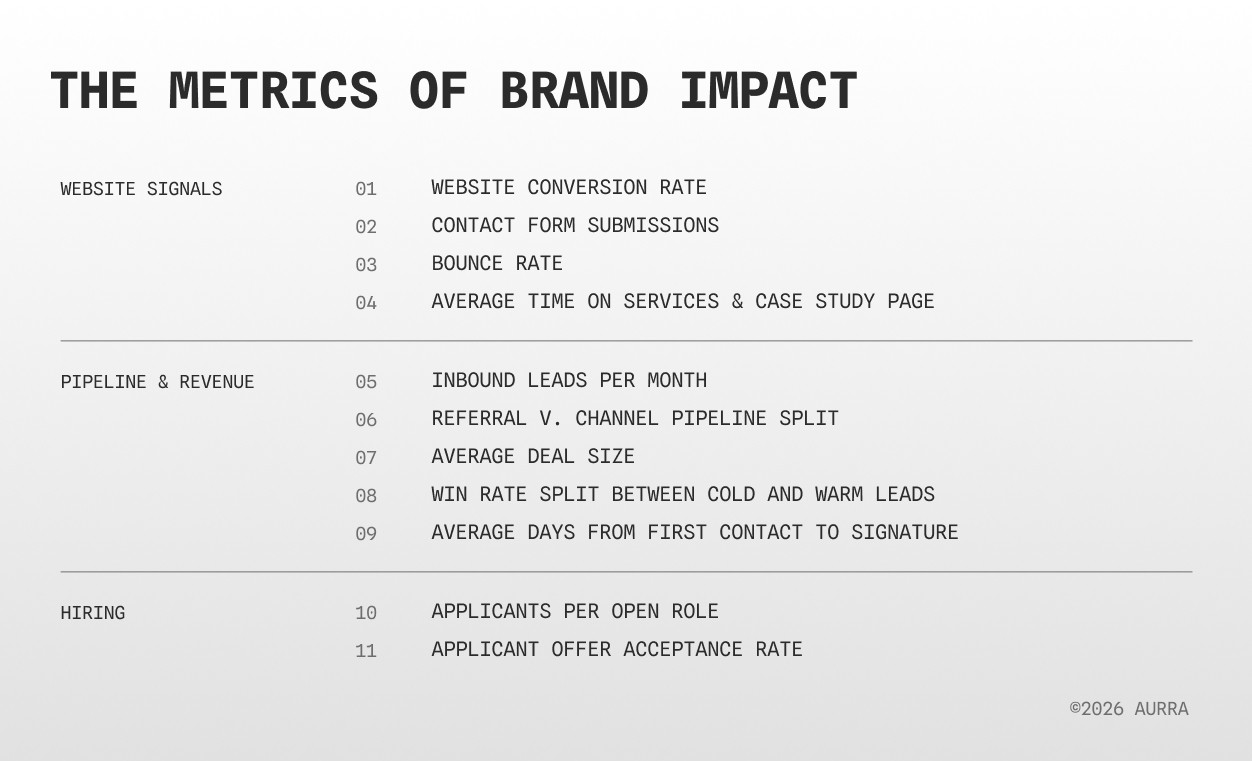
Measure a rebrand against the commercial outcomes you already track. Before the work starts, you want to record where these key metrics sit so that you have a baseline.
Don't start your brand project without this baseline
Pull these numbers in the week before discovery begins, and write them down somewhere you will find them again:
Website conversion rate, and contact form submissions per month
Bounce rate and average time on your services and case study pages
Inbound leads per month, and what share of pipeline arrives inbound rather than through referral or channel
Average deal size, and win rate split between cold prospects and warm intros
Average days from first contact to signature
For hiring, applications per open role and offer acceptance rate
None of this requires new tooling. Most of it sits in your analytics and CRM already.
What moves, and when:
Signal | Where to look | When it moves |
|---|---|---|
Time on page, bounce rate, pages per session | Analytics | 2 to 6 weeks |
Contact form conversion rate | Analytics | 4 to 8 weeks |
Inbound lead volume and quality | CRM | 1 to 2 quarters |
Share of deals reaching proposal | CRM | 1 to 2 quarters |
Average deal size and price resistance | CRM | 2 to 4 quarters |
Sales cycle length | CRM | 2 to 4 quarters |
Candidate quality and offer acceptance | Hiring records | 2 to 4 quarters |
Outside of metrics, there are a few other shifts you can expect to see following your rebrand. Prospects will start to arrive to calls without you needing to explain what you do and why it matters. They’ll also have a stronger level of baseline trust in you. You may also find that the types of vendors that you’re competing with shift as your rebrand brings you into the company of more established firms.
Who to hire for your rebrand: the 4 talent options
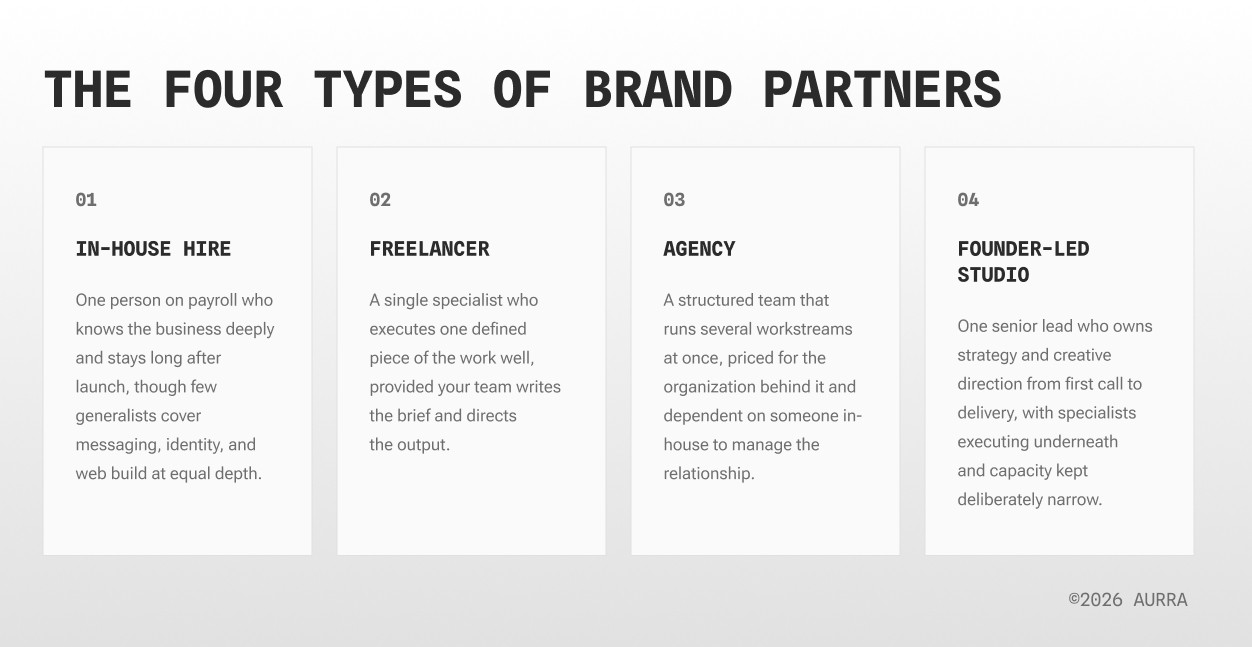
When it comes to who actually owns the rebrand process, you have a number of options available to you. These include in-house hires, solo freelancers, founder-led studios, or mid- or large tier agencies. Each option has its own benefits and drawbacks.
In-house hire
An in-house hire can make sense for your rebrand process when this person has the required skill mix to lead it successfully.
The perks of an in-house person leading your rebrand, is that they will understand the business deeply enough to make sound creative judgment calls, they will have availability for the steady stream of small requests that follow a rebrand, and they will have an institutional memory that outlasts any single project.
The limitation with this option is the skill mix that is required for rebrand success. Brand messaging, identity design, and website design & development are all very different disciplines, and the generalist who covers all three well at a hireable salary is rare.
Cost-wise, the U.S. Bureau of Labor Statistics reports a median annual wage of $138,730 for advertising, promotions, and marketing managers. Benefits, software licenses, and recruiting costs sit on top of that. Against a rebrand that runs a defined number of weeks, an investment in an in-house hire will generate returns when the work continues well past launch.
Freelancers
Freelancers make sense for a rebrand when the scope is narrow, you've already established your positioning and creative direction, and you can be a hands-on voice of discernment to guide the process. For a company that already knows its messaging, has a clear brief, and is capable of giving useful creative feedback, it is possible to get good value from a freelancer.
The constraint with a freelancer is what’s asked of your in-house team: your folks must have the creative sensibility, taste, and skill to direct the output of the rebrand. With many tech firms solely being staffed with technical or analytical teams, this can be a challenge. A team that cannot brief a freelancer well will get work that reflects the brief rather than the business.
Another crucial note here is the need to be wary of how many freelancers the project actually needs. Brand messaging, identity design, website copywriting, UX design, and web development typically require different experts, so a rebrand process often means hiring three people concurrently, briefing them separately in accordance with their project focus, and even potentially coordinating their collaboration—which can get complicated and costly.
Cost-wise, a single freelancer typically runs between $500 and $10,000, depending on scope and seniority.
Agencies
Agencies are a great choice if your rebrand process is more complex and you have the right staff in place to manage the agency relationship.
Mid-tier agencies work well when you need several workstreams running at once and you have a marketing lead who can hold the agency team accountable. If this team member has responsibilities spanning areas like demand generation, event planning, and content strategy, it’s important to consider the bandwidth that will also required for them to manage an agency relationship.
Large agencies handle scale that smaller firms cannot. If your rebrand will involve a multi-market rollout, if you are in a regulated industry with heavy legal requirements, and your procurement processes require a vendor of a certain size, a large agency is likely a strong fit. The limitation with a large agency is the lack of proximity. The senior people who present in the pitch rarely deliver the work, and the day-to-day sits with a team several levels below them. Timelines in this model stretch to accommodate internal process, and the cost reflects the overhead of running an organization rather than the depth or calibre of the work.
Cost-wise, mid-tier agencies typically quote full rebrand engagements in the mid five figures and up, with large agencies starting well into six figures. The difference between these tiers is felt in team size, account structure, and process overhead rather than in strategic depth.
An important caveat to note with agencies is that a larger budget can always buy more people and more process, but it doesn’t necessarily guarantee superior work product. This is especially true nowadays, with AI-native studios producing award-winning work with small and nimble teams.
Founder-Led Studio
The founder-led studio tier sits between the freelancer and the agency. With this model, which is how we operate at Aurra, you receive one senior point of contact who owns strategy, positioning, and creative direction from the first call through delivery, with a specialist team executing at depth underneath. Nobody hands your project to a junior after the pitch call, and nobody needs to be re-briefed halfway through, as the rebrand process with this small of a team is often highly collaborative and intimate.
Also worth noting is how most members of a studio team have agency experience, so they’re typically producing agency-caliber work without the agency price tag.
The tradeoff with hiring a founder-led studio is their limited capacity. A studio takes on a focused number of engagements at once, so this is worth consideration if working with a tighter timeline.
Cost-wise, full engagements covering brand identity and website at this tier start at $10,000 with us. Depth of research and quantity of brand rollout assets inform the final project cost for each client.
Summary: Comparing the Different Types of Brand Partners
Model | Cost | Strength | Where it breaks |
|---|---|---|---|
In-house hire | Salary (median is $138,730) | Continuous ownership | One person rarely covers strategy, design, and build |
Freelancer | $500 to $10,000 | Cost, direct access | You supply the brief and the creative judgment |
Founder-led studio | $10,000 to $25,000 | Senior ownership, agency scope | Limited availability |
Mid-tier agency | $25,000 to $100,000 | Parallel workstreams | Account layers, slower, needs internal management |
Large agency | $100,000+ | Scale and process | Cost, timeline, junior execution on senior budgets |
How do I choose a brand partner?
When it comes to choosing a brand partner, there are a few criteria we recommend ensuring in your project:
Starting with discovery. A brand project that moves straight into the creative process without market research will rely on guesswork and assumptions. Not every project has include granular 1:1 customer interviews, but at minimum, we recommend an onboarding questionnaire or workshop session to explore what's required for market resonance and distinction.
Transparency around team roles and communication for how the work gets done. Especially the case for agencies, it’s important to understand the dynamic between the folks pitching and those that will actually execute on the work. If senior talent are only brought in for occasional direction, it may be that the work you’re receiving is junior-produced. When working with an agency, this could lead to a disparity between your investment level and the caliber of outcomes. For founder-led studios, too, you’ll want to be clear on whether you'll be interacting with just the founder or their larger team.
A defined process on course correction if the first direction misses. It’s imperative that your contract detail the rounds of revisions included for each of your deliverables. Your partner should share the additional costs to expect if you need more revisions than what's specified.
Clarity on how intellectual property is assigned. At the negotiation stage, you’ll want to ensure you’re clear on what you own from the process: Source files, fonts with licenses, website access, and documentation. Be sure this is expressly outlined in your contract agreement.
Rebrand case study: Cloudworkz
Cloudworkz is an AWS consultancy with delivery teams operating across the Nordics and Benelux.
This team engaged us as their capabilities had outgrown their brand presentation. Leadership had decided it was time for their identity to match the caliber of the technical work they produced.
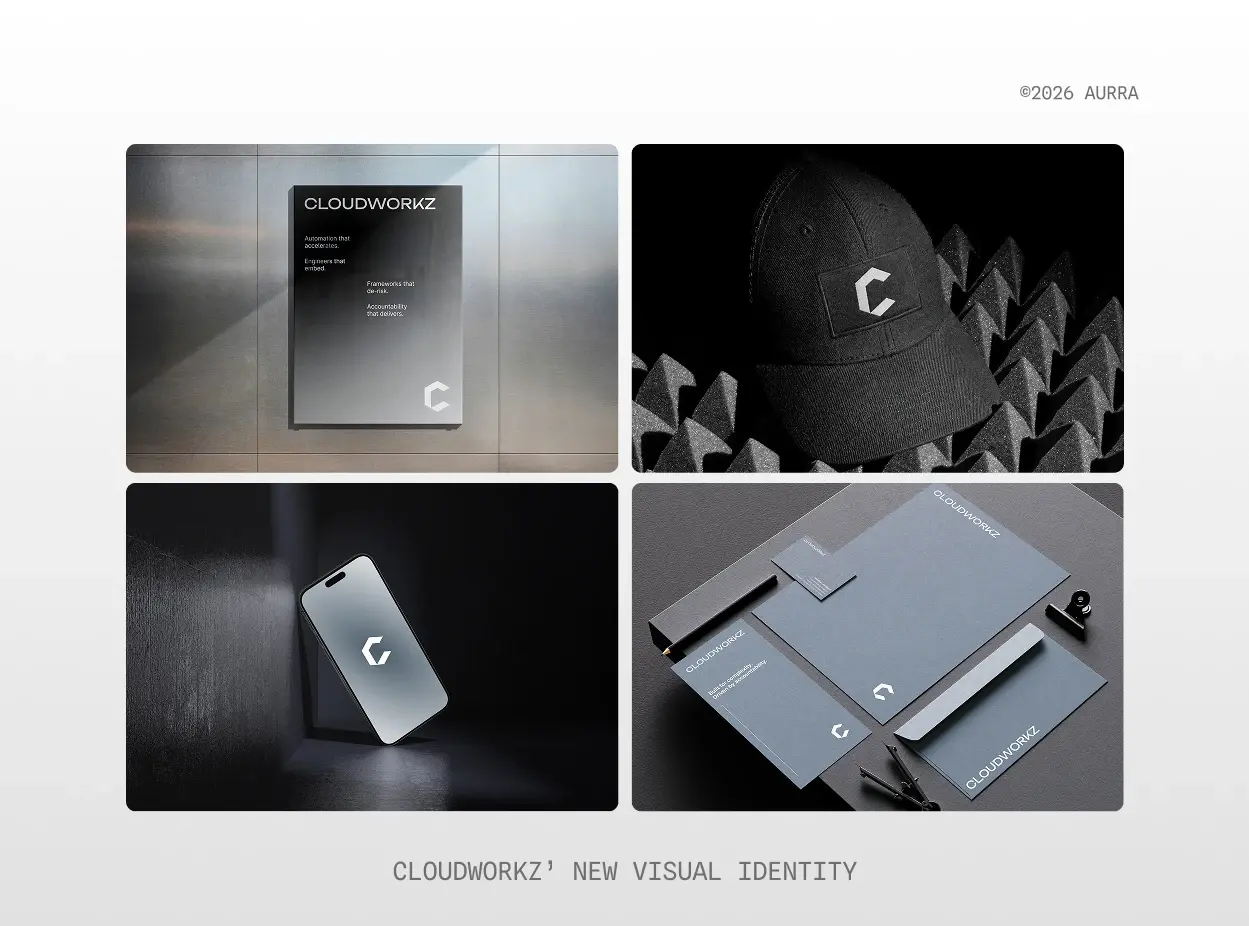
Before working with us, Cloudworkz did not have a brand mark, color palette, or typography system. Their website described their services, but it gave an enterprise buyer little reason to believe in their capacity. No longer wanting to rely on the AWS partner marketplace for client acquisition, the Cloudworkz team was ready for a completely new visual identity, website, and suite of marketing materials.
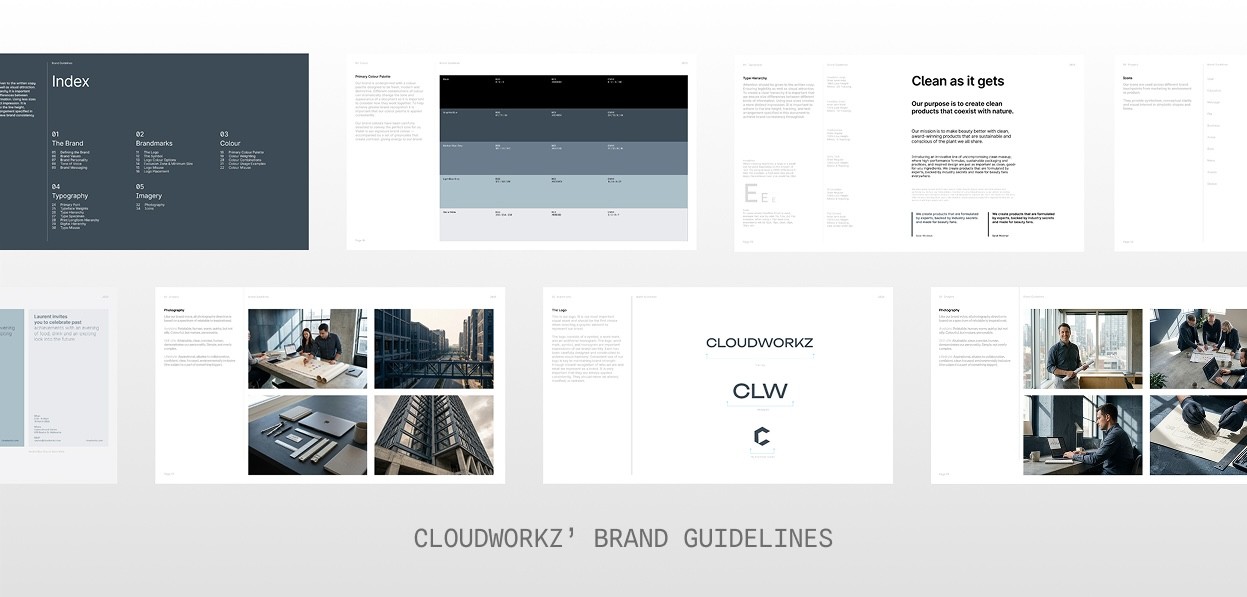
In response, we led a total brand overhaul for them, building the firm’s new brand from the ground up. Our work spanned rebuilding their visual identity as a complete system, including a wordmark, mark, color, typography, and documented rules for application across digital and sales materials. We also built an entirely new website to showcase Cloudworkz’ solutions, case studies, and impact for both enterprise clients and prospective talent alike.
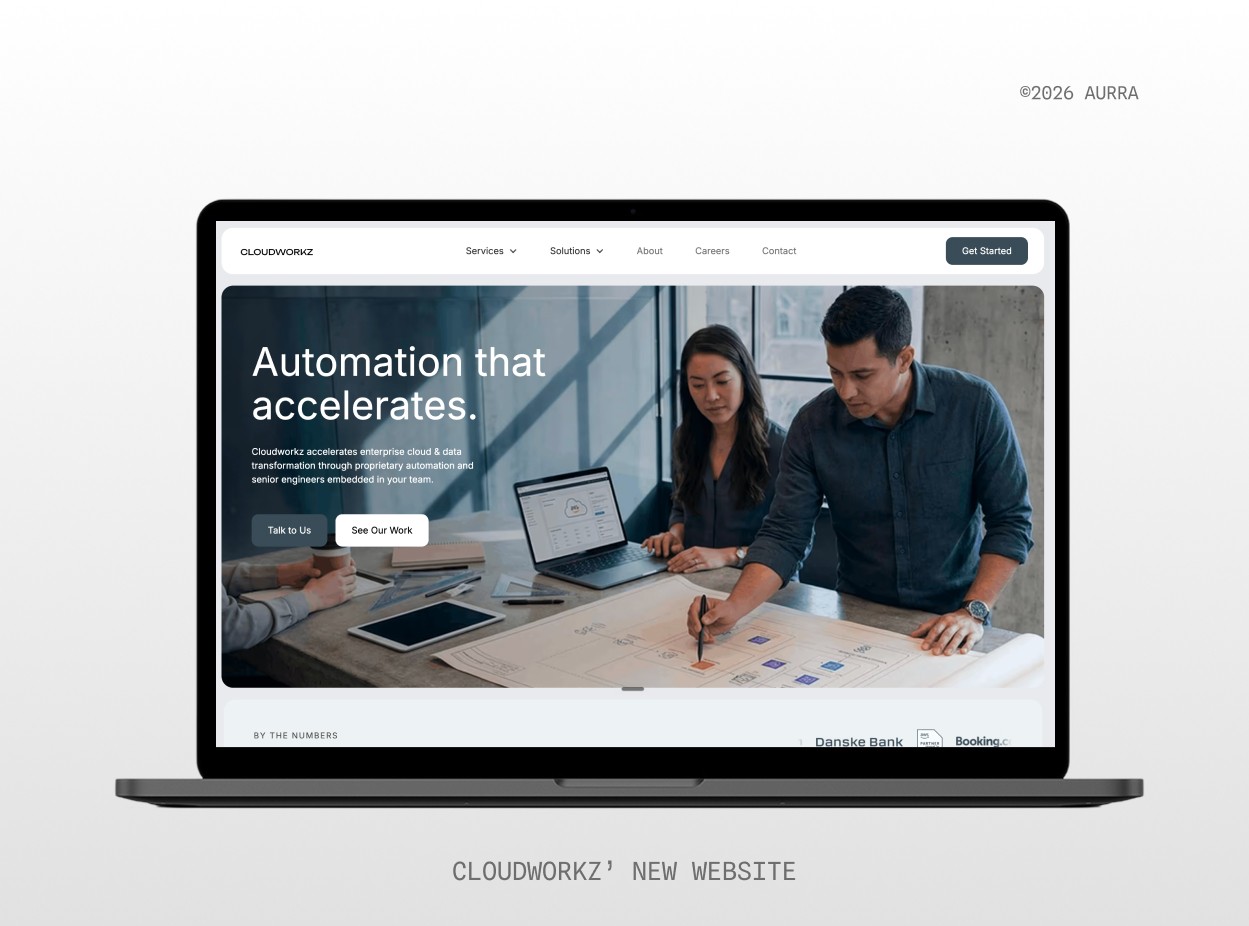
On the other side of our collaboration, Cloudworkz unveiled their new identity and website to rave reviews. Leadership was equipped with a suite of polished presentation materials, with guidelines and governance that ensured staff at all levels could produce professional collateral to represent the firm well. The team was finally able to start directing prospects and talent to the company website with pride, knowing it would do the heavy lifting they needed it to.
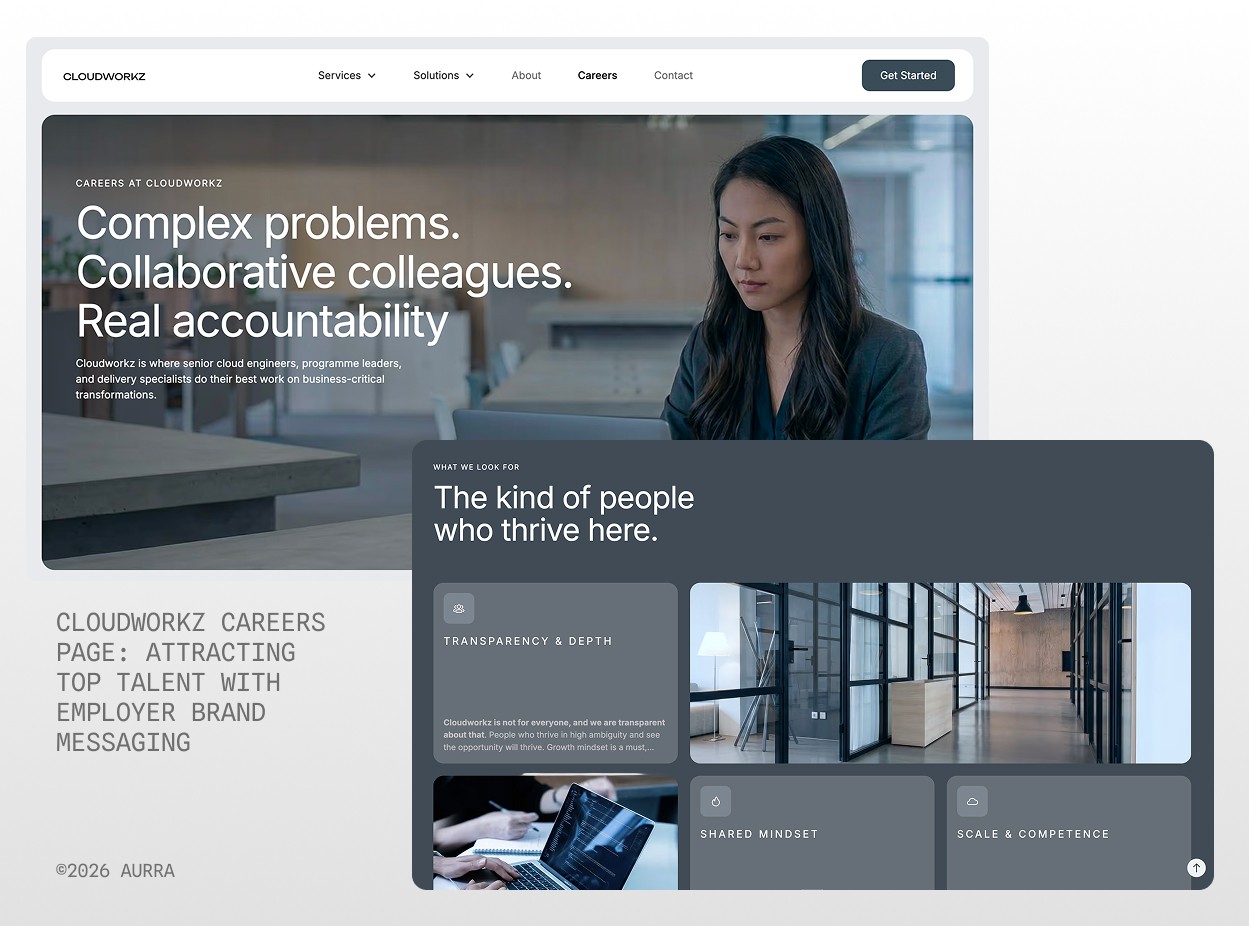
As we worked from a blank slate for the Cloudworkz website and brand, this overhaul made a significant impact for their business development and client acquisition efforts. Though not all clients require the same extent of overhaul that we conducted for this team, this project offers a glimpse into how a typical Aurra project is led, and what to expect on the other side of the investment. To share the client’s own words:
"Carly is a clear communicator, well structured and keeps the status of the delivery visible at all stages. We are glad about the ownership, creativity, transparency and flexibility from her which led to act as a team and achieve successful results. The quality of the delivery was extreme and we received super positive feedback."
FAQ: Frequently asked questions about B2B rebranding
How often should a B2B company rebrand?
The answer to this question is highly circumstantial and depends on your industry. Instead of considering a rebrand need through the lens of time, we recommend evaluating shifts in your services and solutions, new trends in your market and competitive landscape, and/or reputational factors to discern if an update makes sense for you.
Will we lose SEO if we rebrand?
The risk of diminishing SEO performance with a rebrand is only with poor execution. Domain changes, URL changes, and site rebuilds all carry risk, but a proper redirect map plus preserved page structure protects existing rankings. We recommend planning the technical migration before the design work finishes.
Do we have to change our name?
If you are not in the market for a total brand overhaul, we don't recommend changing your name. Unless the name describes something you no longer do, poses a legal risk, or carries a reputation you need to leave behind, our honest perspective is that it's not often worth the required effort to rename your company.
How do we tell our clients about our rebrand?
A brand refresh needs no formal announcement in most cases. A brand overhaul - depending on how significant it is - could merit one. Especially for firms that are embracing a totally new visual identity, we recommend measures of direct outreach to active clients before public launch, a short explanation of what’s changing and what will not, and a clear confirmation that contracts, contacts, and delivery will remain unaffected.
What if our leadership team disagrees about the direction of our brand?
Disagreement about brand creative direction can be avoided by rigorous market research and diligent collection of all stakeholder perspectives at the project's start. We (1) recommend studying competitors/ICPs and (2) conducting 1:1 interviews/workshops with key leaders to gain their views on the brand. The more that you can ground your creative decisions in market data and points of internal consensus, the easier it will be to align on a direction.
Conclusion: How to decide what your company needs
Regardless of whether a brand refresh or brand overhaul is the best fit for you, you have an array of options for the brand partner you bring on, the scope you choose to execute on, how you can measure the brand’s impact on the business, and the level of investment you commit to the process. Here’s what to carry with you into your rebrand effort:
If you're uncertain regarding your need for a rebrand, there are a few classic signs that it's time. Stalled deals and lost candidates will tell you more about brand health than any internal opinion about the logo.
Be mindful of your baseline brand metrics across website signals, pipeline, and hiring before you start on your rebrand. That way, you can actually measure the impact on the other side of the investment.
Scope around the problem, not the budget. As is the case with any creative work, you can expect the output to reflect your input. Opting for the cheapest available brand creative will reveal itself in the end result. Especially with the vehement public response against AI slop, a solid brand budget is only that much more of a requirement. Just because more people and process are involved in a brand project, it doesn't necessarily guarantee superior work product (especially as we see the rise of AI-native, founder-led brand studios with extremely lean teams.)
The rebrand process should involve the same steps regardless of whether you are opting for a light refresh or a total overhaul of your identity: Research, positioning, visual identity, website, and rollout. Though the depth of each of these phases is different for every company, the sequence should stay the same.
Navigating the rebrand process? Let's connect.
If you're weighing a rebrand decision, get in touch with us.